
A History of Success
While he never could have imagined it, the Zurich lab's first director Ambros Speiser made a significant dent in the history of science when he helped build IBM's first research lab outside of the United States.
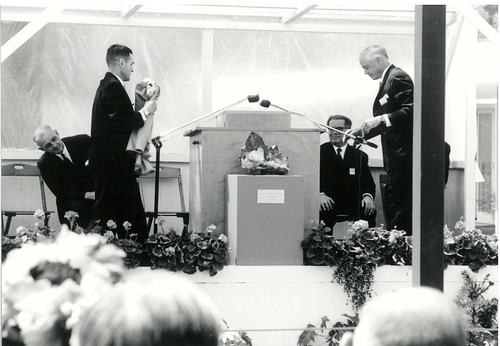 |
| From left to right, AP Speiser, lab director and Thomas Watson Jr, CEO of IBM, at the opening of the Rüschlikon lab on May 22, 1963. |
In 1986, Gerd Binnig and the late Heinrich Rohrer received the Nobel Prize for physics for their invention of the scanning tunneling microscope. Only one year later, Georg Bednorz and K. Alex Müller received the same award for their discovery of high-temperature superconductivity.
Other breakthroughs include the token ring, the secure electronic transaction protocol, storage sequence detection and energy efficient supercomputers.
Since its founding 50 years ago, the Zurich laboratory has grown its spectrum of research areas, which now ranges from exploratory research to software and services, such as the optimization of supply chains and trains schedules and routing.
Why Switzerland?
 |
| Original invitation to the opening in 1963. |
Switzerland wasn’t IBM’s first option for a European research lab. In 1955, an IBM electrical engineer named Arthur Samuel was tasked with scouting the final short list of cities. IBM eventually selected Switzerland for its proximity to talent, which included access to universities, such as ETH Zurich. The country is also an attractive place to live for expatriates -- today, employees from 45 different nationalities currently work at the lab.
The Zurich Lab Today
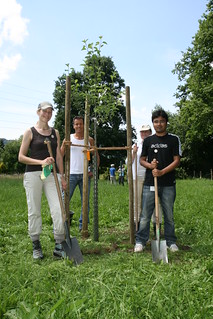 |
| Scientists at the Zurich Lab planted trees in Rueschlikon in 2011. |
The expansion in Zurich continued well into 2000s. Today, there are five departments including storage, computer science and systems, in addition to physics (science and technology) and mathematics (mathematics and computational sciences).
In addition, the lab has a new cutting edge facility called the Binnig and Rohrer Nanotechnology Center, named for the two Nobel Laureates. Speiser’s intuition to keep the lab close to ETH Zurich proved prescient. Nobel Laureates K. Alex Müller, Georg Bednorz and Heinrich Rohrer all came from ETH. And now, five decades later, the partners' $90 million facility features a large clean room and six noise-free labs unlike any in the world.
In addition to exploring nanotech, IBM scientists are working on some of the greatest challenges of our society today, including:
- ASTRON, The Netherlands Institute for Radio Astronomy, and IBM are collaborating on a 32.9 million euro, five-year project to build an extremely fast, but low-power exascale computer systems targeted for the Square Kilometre Array (SKA). The SKA is an international consortium to build the world’s largest and most sensitive radio telescope. Scientists estimate that the processing power required to operate the telescope will be equal to several millions of today’s fastest computers.
- IBM’s Battery 500 project, led by scientists at IBM Research – Almaden in California, is an interdisciplinary consortium to develop a lithium–air battery that aims to increase the range of electric vehicles to 500 miles (approximately 800 km). This is more than five times the range of today’s batteries, which average some 150 km per charge. If the project is successful, battery-powered vehicles could finally become a practical reality and thus overcome the main obstacle to becoming generally accepted and widespread. In a recent survey conducted by IBM, 64% of consumers said that the limited range was their strongest objection to driving electric vehicles.
- To improve the much-strained energy grid, IBM scientists are collaborating with utility companies in Denmark and Switzerland to improve the balance between demand and the supply of renewable energy in projects including EcoGrid EU and Flexlast.
No comments:
Post a Comment